
Contents
You can use your registered agent’s Florida street address in the registered agent section of your LLC filing. But can you put the same address in the principal office and mailing address boxes? Only when that address genuinely meets each field’s requirements and the provider authorizes the use. Hiring a registered agent doesn’t automatically turn the agent’s office into your company’s principal office.
That distinction may sound small until you are actually completing the application.
Suppose you run a consulting business from home and want to avoid putting your residential address on Sunbiz. You hire a Florida registered agent, enter its address where the state asks for the agent, and then reach the principal office field. Do you enter your home address? The agent’s? An address you bought from another provider?
If you guess, you could end up publishing the exact information you were trying to protect.
Florida asks for addresses that serve different purposes. Understanding those purposes before submission is more useful than assuming a single purchased address solves everything.
Can I Use My Registered Agent’s Address as My Florida LLC Principal Office?
Not automatically. Your registered agent’s address is valid for the registered agent field when the agent meets Florida’s requirements and accepts the appointment. You may use that same address as your LLC’s principal office only if it genuinely serves as the principal office address and its use is authorized. Simply paying for registered agent service does not make the agent’s office your company’s principal office.
Think of it this way: renting a mailbox doesn’t move your business into the post office. And hiring a registered agent doesn’t move your principal office into the agent’s building. The address has to fit the purpose of the field, not merely fit inside the box.
Which Addresses Does Florida Ask for When You Form an LLC?
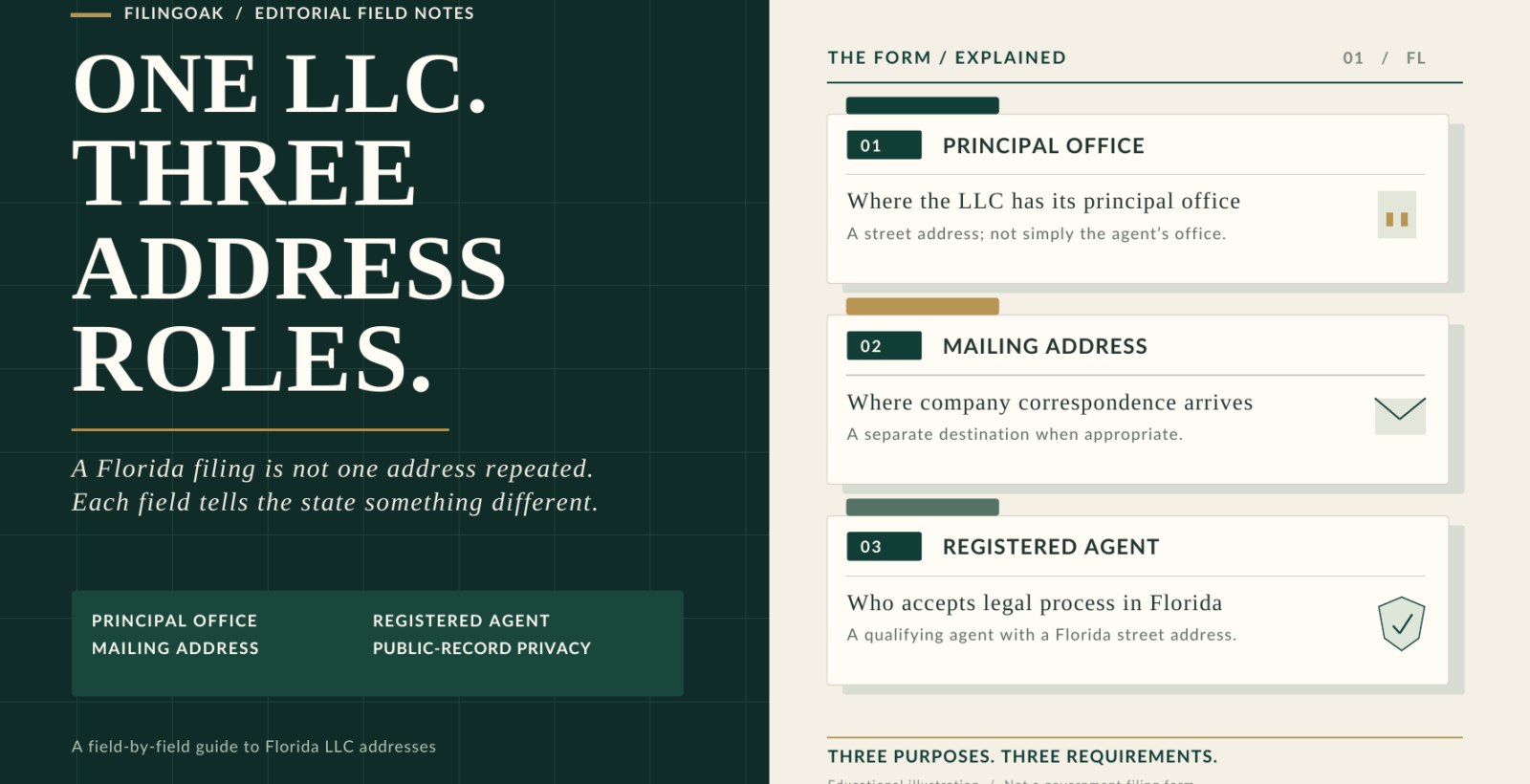
Florida’s Articles of Organization asks for the company’s principal office information, its mailing address, and the name and Florida street address of the registered agent. These are separate entries because they tell the state different things.
| Field | What you are telling Florida | P.O. box? |
|---|---|---|
| Principal office | The LLC’s principal office street address | Not for the street-address field |
| Mailing address | Where the LLC receives correspondence | Permitted |
| Registered agent | Who accepts service of process and where the agent is located in Florida | Not permitted |
The starting point is the Florida Division of Corporations’ LLC filing instructions. Florida Statutes §605.0201 requires the principal office street and mailing addresses and the initial registered agent’s name, Florida street address, and written acceptance.
Principal Place of Business Address
This field is about the LLC’s principal office. It is not a general-purpose box where you can put whichever address is easiest to obtain.
Imagine that you work from your own office in Georgia but are forming a Florida LLC. Your registered agent is in Florida because Florida requires a qualifying registered agent there. That does not mean your principal office suddenly moved to the registered agent’s building. A Florida LLC’s principal office can be outside Florida.
Now take a different example. You work from home and pay for an address service. The provider says you can use its address for business mail. Does that statement alone make the address your principal office?
Not necessarily. Authorization from the provider matters, but so does the purpose and factual accuracy of the field. “You may receive mail here” and “this is your LLC’s principal office” are not identical statements.
This is why you should identify what the state is actually asking before you decide what to enter. A real address is not automatically the right address for every field.
Mailing Address
Your mailing address answers a more practical question: where should correspondence to the LLC arrive?
You may have a principal office at one location and choose to receive mail somewhere else. Florida permits a P.O. box for the mailing address; that permission does not carry over to the principal office street-address field or the registered agent’s physical Florida office.
But an address alone cannot receive and handle mail for you.
Suppose you are traveling, or you are running your LLC from outside the United States. You might prefer someone to receive letters, notify you, and forward or scan documents. That can be useful, but ask exactly what that service includes.
Does it receive routine business letters? State correspondence? Letters from a financial institution? Will it scan everything or only certain categories? How quickly will it notify you? Who gets the mail when your subscription ends?
Those details turn an address on paper into a workable correspondence arrangement. Without them, you might send important mail to a location where nobody has agreed to handle it.
Registered Agent Name and Address
A registered agent has a specific legal role. The agent maintains the required registered office in Florida and receives service of process for the LLC. The agent must be eligible, use a physical Florida street address, and accept the appointment.
You may be eligible to act as your own registered agent if you meet the state’s requirements. Or you may hire an outside provider. What you cannot do is copy a convenient Florida address into the form and assume you have appointed an agent.
The agent needs to be the actual eligible person or qualifying entity accepting the responsibility. The registered agent’s acceptance and the signature executing the Articles of Organization are separate requirements.
See Florida Statutes §605.0113 and the official formation instructions.
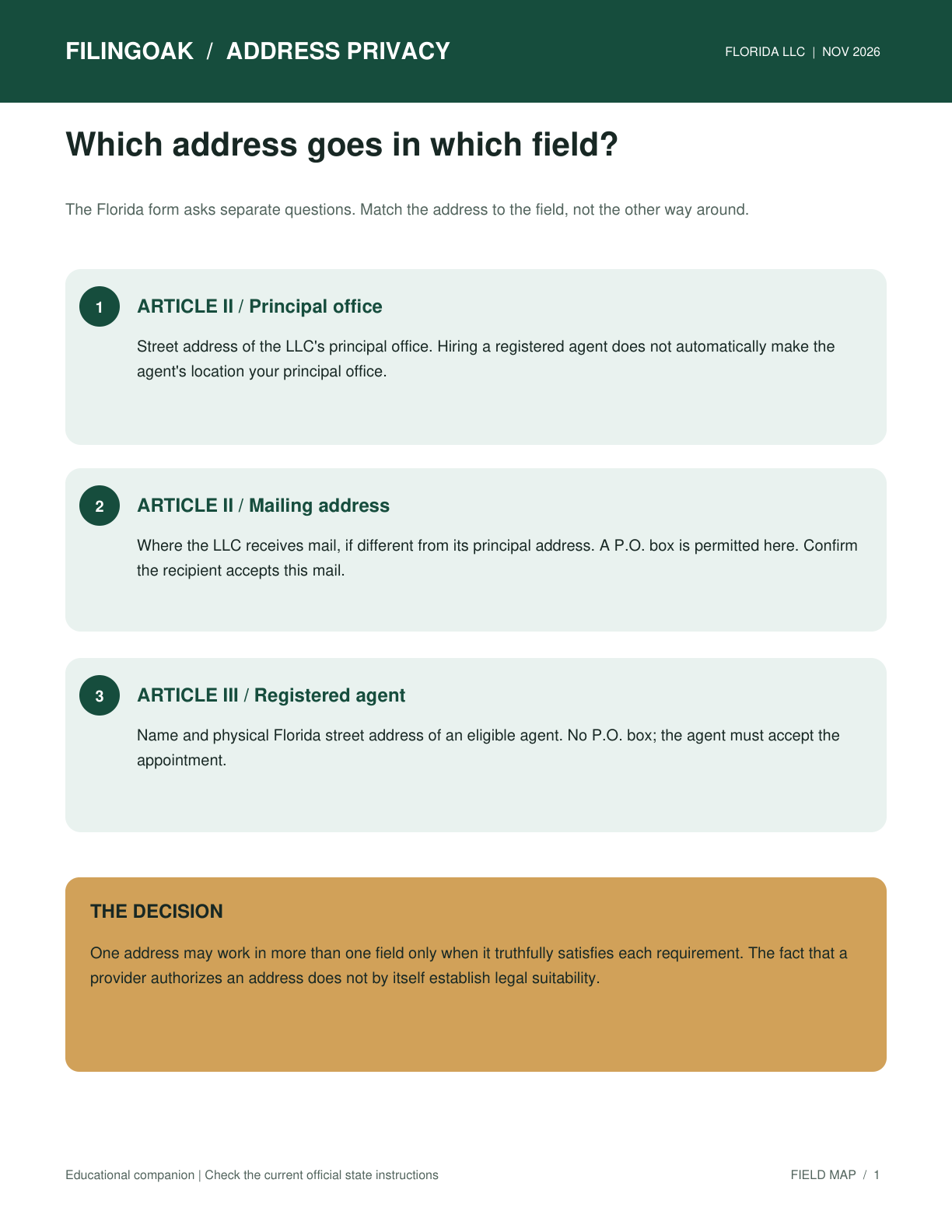
The field map is an educational companion, not an official form. You can compare it with the Florida Articles of Organization while reviewing the state’s instructions.
Can the Same Address Go in More Than One Field?
Yes. Florida does not require every address field to contain a different location. The real question is whether the same location actually serves each role.
Suppose you operate your business from a qualifying office in Miami. You are eligible to serve as the LLC’s registered agent, you accept that appointment, and you also receive the company’s ordinary correspondence at that office. Depending on the actual circumstances, the same physical street address could legitimately appear in several fields.
Now change just one fact: you are operating from home in Orlando, but your commercial registered agent has an office in Tallahassee.
The Tallahassee address belongs in the registered agent field because that is where the agent performs the required role. It does not become your principal office solely because you hired the agent.
Could you use it for mailing too? Maybe, if the provider offers and authorizes a suitable mail service and that address is where the LLC will receive its correspondence. But even then, its mailing function does not automatically make it your principal office.
You see the difference? Florida is not asking you to collect three different addresses just for the sake of it. It is asking you to identify distinct business facts and legal responsibilities.
If a company has one location that genuinely satisfies multiple roles, that may be fine. If the roles are served by different arrangements, the filing should reflect that reality.
What Information Will People See on Sunbiz?
When you file Florida’s Articles of Organization, the information you submit becomes part of the public record. Someone searching for your LLC does not need to be your customer or a government employee to find its state business record.
That makes your pre-filing review important.
| Information entered on the filing | Public-record consideration |
|---|---|
| LLC name | Appears in the state business record |
| Principal office address | Included in the public filing |
| Mailing address | Included when submitted |
| Registered agent name and Florida address | Included in the record |
| Manager or authorized representative information | Public if included |
| Filed formation documents | Can be accessible through state records |
Consider what happens if you list an outside registered agent but enter your home address as the principal office. The agent’s separate address does not erase your home address from the principal office field. They are two public entries for two different purposes.
And privacy is not limited to addresses. Other information you type into a government filing deserves the same attention.
Do You Have to List Your Name as an LLC Manager or Member?
Florida’s online instructions describe manager or authorized representative name-and-address entries as optional at formation. That is useful to know, but it should not be mistaken for permission to conceal information that another law, filing, or institution genuinely requires.
For example, a bank may need certain management information visible on the state record as part of its own business-account review. Your ownership and management arrangements should determine what you provide, not a made-up structure that only looks more private.
There is also a difference between what the online formation interface asks for and what Florida law permits an LLC to include as additional information. Check the current form and the needs of your actual business before choosing whether to add optional entries.
Does Someone Still Have to Sign the Filing?
Yes. Leaving an optional manager listing blank does not mean the Articles of Organization can go unsigned.
Under §605.0201, one or more authorized representatives sign and deliver the Articles of Organization for filing. Florida also requires the initial registered agent’s written acceptance.
Those steps serve different purposes. The authorized representative executes the formation document. The registered agent accepts the agent’s responsibilities.
If somebody is preparing the filing for you, understand whose name is being entered, in what capacity, and whether that person is authorized to sign.
What About Your Email Address and Phone Number?
This is easy to overlook when your attention is on street addresses.
Florida asks for a correspondence email address in its online filing process. Email addresses may also be subject to the state’s public-record rules. A business owner who wants to keep a personal inbox separate from public-facing company information should think about this before entering it.
And if a particular government filing asks for a telephone number, check why the number is requested and whether the form permits a service provider’s business contact details.
Your personal phone might be the number your family and friends call every day. Would you automatically want that number written into every business-related form that asks for a contact? Probably not. But the correct alternative depends on what the form permits, not simply on what you prefer.
Where the applicable state filing allows it, FilingOak uses Enterobiz LLC’s official business email address and telephone number as filing contact details. That helps avoid unnecessary exposure of customers’ personal inboxes and numbers in those fields. It does not replace a real owner, responsible party, or personal contact detail that a particular agency lawfully requires.
It also gives state correspondence a designated destination: FilingOak reviews relevant communications and passes legitimate official notices and documents to the customer.
Can You Remove Your Home Address After Filing?
Florida provides ways to update company information. But changing what a current business record displays is not the same as making an earlier filed document disappear.
Suppose you file today with your home address and change the principal office address next month. Even if the current listing updates, earlier submissions may remain accessible in the filing history, subject to applicable public-record rules.
That is why the best time to review potentially public personal information is before the application goes out.
For changes after formation, use Florida’s business information update procedures.
Does Hiring a Registered Agent Keep My Home Address Private?
No, not by itself. A commercial registered agent gives you a separate qualifying Florida registered office. It does not automatically supply an appropriate principal office address, a general mailing service, or a solution to every public-facing contact field.
If you are starting your LLC from home, that is worth understanding before you pay for a service advertised simply as “privacy.”
A service can be perfectly legitimate and still solve only one part of your problem.
What happens to the principal office entry? Where will ordinary correspondence arrive? Who will handle filing notices? Which email address will the state use? Those questions are connected, but they do not all have the same answer.
How FilingOak Approaches Privacy Field by Field
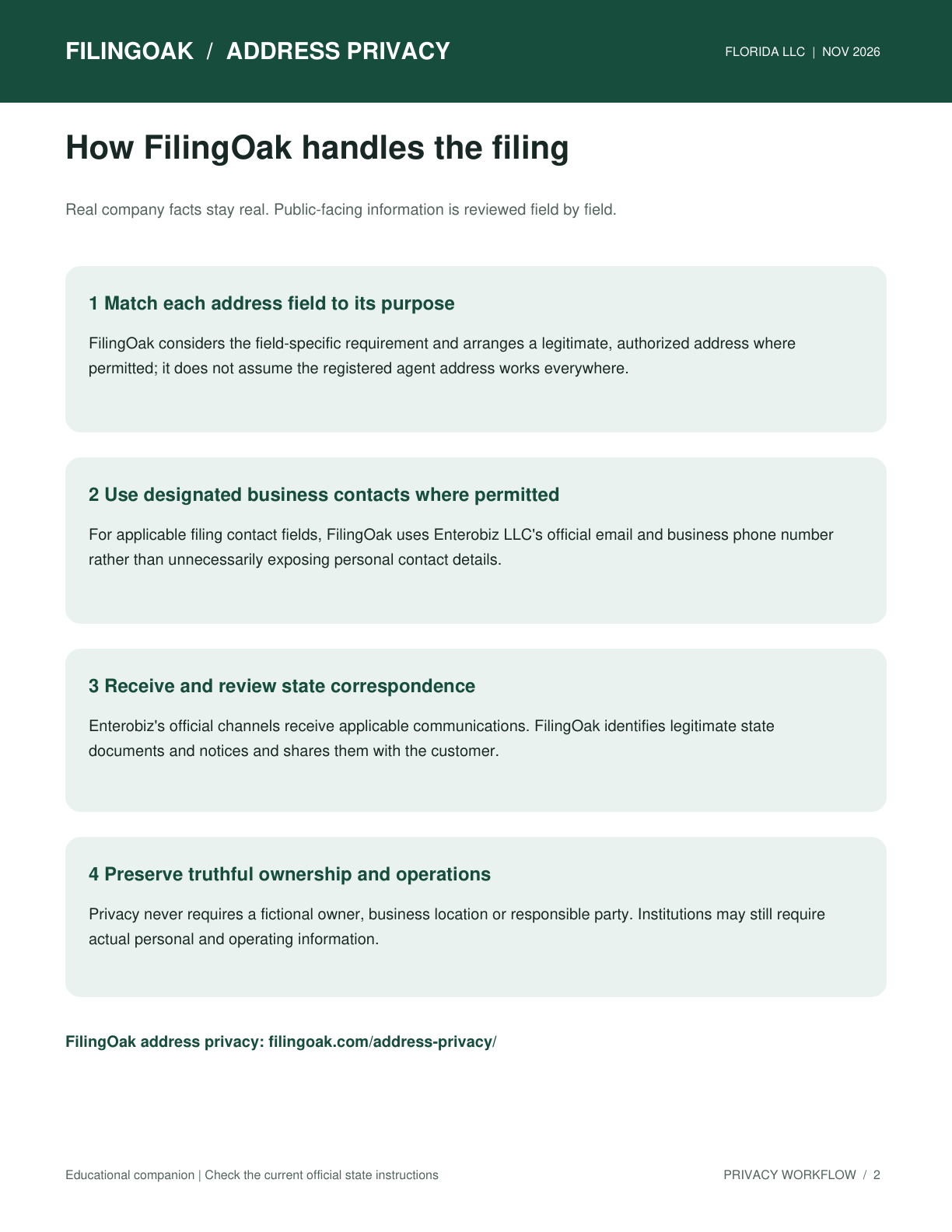
FilingOak’s formation process starts by distinguishing the fields rather than assuming the registered agent address works everywhere.
For each applicable filing, FilingOak evaluates what the field requires and arranges an appropriate, authorized address where legally permitted. Before submission, the filing details should be reviewed so the address choices are understood and accurate. The choice of an authorized public filing address remains separate from the company’s actual ownership, operations, and other facts.
That same approach extends to contact information. Where permitted, FilingOak uses Enterobiz LLC’s official email and telephone number for relevant state filing correspondence, instead of unnecessarily placing the customer’s personal contact details in those fields.
A practical benefit follows: official filing communications go through an established business channel. FilingOak reviews relevant messages, distinguishes legitimate communications from unsolicited solicitations, and shares the documents or notices customers actually need. It cannot promise that every misleading message will be prevented, but it can keep the filing workflow organized.
This is not a claim that public-record privacy erases every identity requirement. A bank, payment processor, the IRS, or a government agency may need your real residential address, responsible party details, business location, or proof of identity. FilingOak does not invent founders, owners, or business premises to avoid those obligations.
If you want to understand this distinction more closely, see FilingOak’s Address Privacy service. If you intend to form the LLC yourself and only need an eligible agent, review the Registered Agent Service separately.
What Should I Ask an Address Provider Before I File?
Before you buy an address service, you should be able to explain what you are buying in plain English.
An advertisement might say “Florida business address,” “registered agent,” “virtual office,” or “mail forwarding.” Those terms sound related, but the agreement may cover very different things. Four questions usually make the distinction clearer.
1. Which Filing Fields Am I Allowed to Use This Address In?
Ask about the principal office, mailing address, and registered agent fields separately. Don’t accept “you can use this as your business address” as a complete answer.
For which purposes is the address authorized? Does it actually meet the relevant state requirement? If a provider says the address is suitable for a specific filing field, ask what the service arrangement means in practice.
A provider’s permission matters. So does the truthfulness of the filing.
2. What Types of Mail Will You Accept?
Does the provider accept only legal service documents, or also ordinary correspondence? Will it handle state notices, banking letters, and other business communications?
Imagine forwarding an important government letter to a location that only receives service of process. The address may be real, but the service you needed was never included.
The difference becomes painfully practical when a document requires action.
3. How Will I Receive My Mail and Important Documents?
Will somebody scan incoming letters, forward the originals, notify you by email, or post copies in an account? Are there extra charges, volume limits, or processing delays?
If you live overseas or travel frequently, this matters even more. A document arriving in Florida is not the same as that document reaching you in time.
Ask who monitors the incoming mail and what happens when the message is urgent.
4. What Happens to My Address and Mail if I Cancel?
Picture your second year of business. You decide to change providers, move, or handle correspondence differently.
Can you keep using the address? Will mail be forwarded temporarily? What happens to undelivered mail? Do you need to update your Florida principal office or mailing information? If you are replacing your registered agent, how will the successor appointment be filed?
A good arrangement should be understandable when you leave, not only when you sign up.
A Message You Can Send Before Purchasing
I’m forming a Florida LLC and considering your address service. Could you confirm which fields of the Articles of Organization I’m authorized to use your address for, what types of mail you receive, how documents are delivered to me, and what happens to the address and incoming mail if I cancel?
You do not need to make it more complicated than that. Keep the provider’s answer with your formation records. If something is vague, resolve it before you submit the application.
What Should I Check Before Submitting My Florida LLC?
Take one final look at the actual Articles of Organization. Not merely to catch a spelling mistake, but to make sure every address and contact detail tells the state what it is supposed to tell the state.
Use Florida’s official filing instructions beside your entries.
Principal Office
Does this street address accurately satisfy the principal office requirement? If it belongs to a third-party provider, have you confirmed both the authorized use and the factual suitability of that arrangement?
Do not paste the registered agent address here automatically just because it is the only Florida address you have.
Mailing Address
Will company correspondence actually be delivered to someone responsible for receiving it? If you are using a mail provider, do you know what mail it accepts and how it reaches you?
A mailbox that no one monitors is not much of a correspondence solution.
Registered Agent
Have you entered the correct agent name and physical Florida address? Is the agent eligible and properly accepting the appointment? Is any signature entered on the agent’s behalf authorized?
This is a legal responsibility, not simply a location on a map.
Signatures and Other Public Information
Have the required formation and agent acceptance steps been completed? If you included optional management or representative information, did you consider why it is there and whether it needs to be public?
Scan the entire filing for residential addresses and personal details you did not mean to submit.
Email, Phone and Delivery After Filing
Which email will receive the state acknowledgment? Does the particular filing request a phone number? Where permitted, are the chosen business contact details appropriate and monitored?
If a service is filing on your behalf, you should know how the completed documents, government notices, and any follow-up requests reach you.
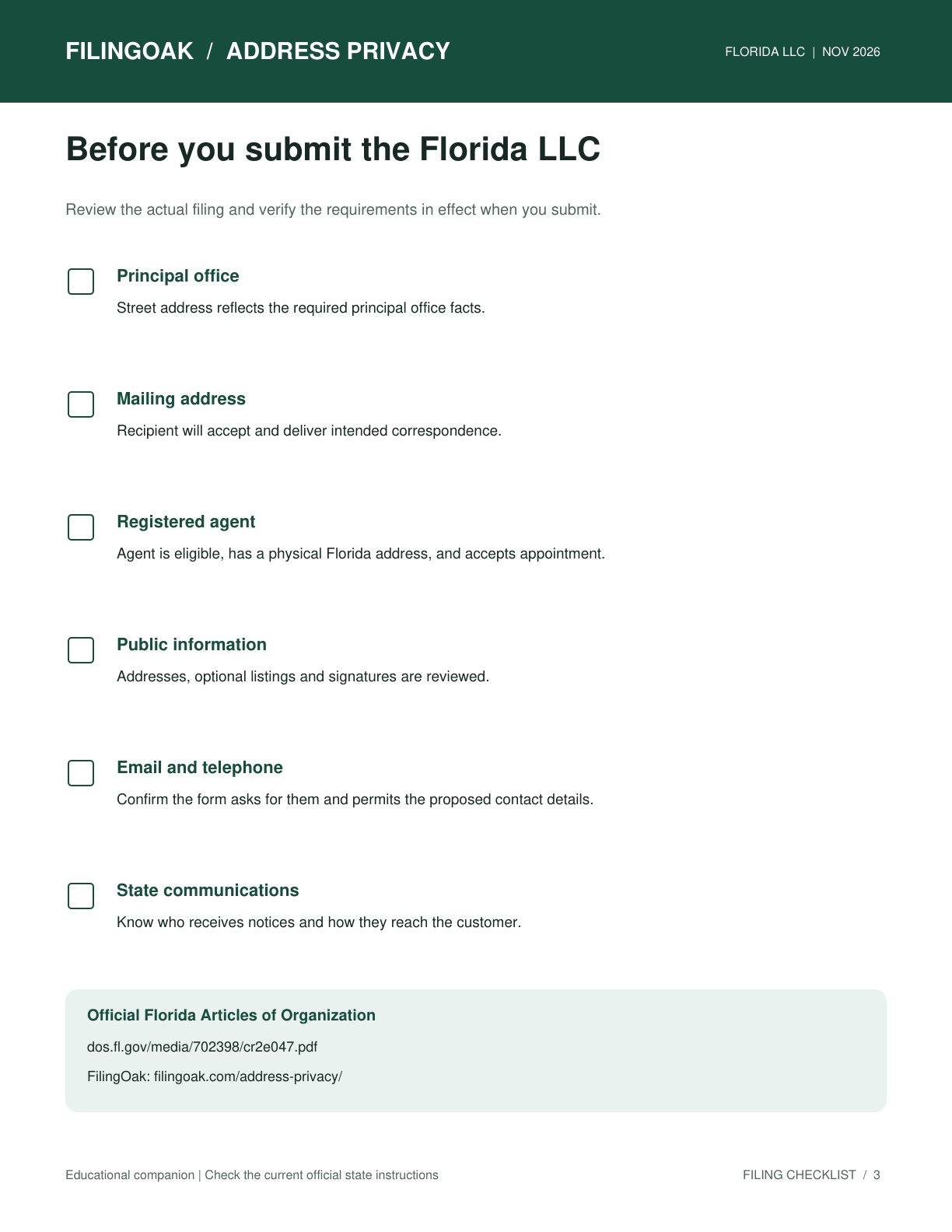
Download the free three-page Florida LLC Address Privacy Companion (PDF) — a field-by-field visual reference and checklist to use alongside Florida’s official form.
One final thought: you are not trying to win a game of fitting one address into three boxes. You are making a public government filing that should reflect the real company and also avoid unnecessary personal exposure.
Those goals do not need to conflict.
Check what every field means, verify that the arrangement actually serves that purpose, and review what will become public before you click submit.
Want FilingOak to Handle Your Florida LLC Filing?
You can absolutely form your Florida LLC yourself. The official state instructions are there for that, and now you know which address questions deserve attention before filing.
But if you would rather have someone handle the filing while thinking through the principal office, mailing address, registered agent, and public-facing contact details with you, that is exactly the kind of work FilingOak is built around. We look at the fields individually instead of blindly reusing one address everywhere. Where the state permits it, we use appropriate authorized address arrangements and Enterobiz LLC’s official business contact information to reduce unnecessary exposure of your personal details.
Explore FilingOak’s LLC formation service if you want FilingOak to handle the process. If you’re preparing the filing yourself and only need a Florida registered agent, you can also review our registered agent service. Either way, understand the addresses before you submit them; that part matters more than which service you choose.


0 Comments
Questions, corrections, and useful additions are welcome.