
Contents
In August 2025, I stopped working with the man who had been obtaining EINs for my customers. I had discovered that he was getting 98-prefix EINs for LLCs formed in the United States. When I confronted him, he defended the method because the numbers were genuine. Then he explained how he dealt with the IRS. He told me that the caller presented himself as the LLC owner to obtain the EIN, then called again under that identity to request Letter 147C at a fax number under the provider’s control.
What he described was fraud, not innovation. A caller impersonating an LLC owner before the IRS is not an authorized representative. Using the foreign-entity EIN classification for a US-domestic LLC does not become legitimate because the IRS issues a genuine number. Obtaining Letter 147C by pretending to be the taxpayer is not customer service. I ended the arrangement in August 2025, and a year later I went back to the same marketplace to investigate the people still selling the same kind of astonishingly fast results.
A year later, I returned to Fiverr. I recorded conversations with sellers on August 28, 2026, and conducted another, separate round in October. I also examined independent businesses advertising same-day and next-day EINs. I wanted to know whether the promises being sold to non-US founders had changed and, more importantly, what the providers were actually doing to produce those results.
What the IRS says about the 98-prefix method and Letter 147C
The IRS rule that exposes the 98-prefix scheme: An LLC organized under a US state’s law is domestic even when its owner lives abroad without an SSN or ITIN. The IRS says that when a foreign individual without an ITIN is the responsible party of a domestic entity, that entity receives a regular-series EIN. Prefix 98 applies to the foreign-entity classification, not a special express lane for American LLCs. The IRS instructs its international telephone staff to redirect domestic LLC applicants to the appropriate application methods.
Letter 147C is the second red flag. The IRS expressly instructs employees not to fax or mail Letter 147C to someone acting solely as the Third Party Designee on Form SS-4. That authority does not make a seller the LLC owner or authorize the seller to receive taxpayer correspondence. Properly authorized representatives have separate procedures. My former contractor described evading the identity barrier by having callers present themselves as the owners. A genuine IRS letter does not legitimize that impersonation.
Read the IRS rules directly: IRS Internal Revenue Manual §21.7.13 and IRS Instructions for Form SS-4.
How I ended up paying for this method
In March 2025, I was researching how someone living outside the United States could form an American LLC and obtain an Employer Identification Number without an SSN or ITIN. I wasn’t investigating misconduct. I was learning a business I intended to operate. Fiverr sellers were offering LLC formation, EINs and IRS confirmation letters, sometimes within a day.
I launched Enterobiz in April 2025 and arranged backend fulfillment with a Fiverr seller known as EINbyKhan. I asked him how he obtained EINs so quickly. He told me his sister was an IRS- listed Certifying Acceptance Agent. That sounded like an explanation to me at the time. I knew the credential existed, but I didn’t understand that the IRS acceptance-agent program deals with ITIN matters and does not, by itself, give someone special authority to obtain EINs for domestic LLCs within hours.
My first Enterobiz customer came in July 2025. I passed the work to the contractor, paid him and the state fee, kept my margin and delivered the finished documents. The LLC existed. The IRS documents were genuine. The customer received what he had purchased. I treated successful delivery as evidence that the procedure was legitimate, which was a mistake.
I have retained two IRS confirmation records from this arrangement. One EIN was delivered in approximately 12 hours and another in approximately 18 hours. Both began with 98. The masked copies preserve the relevant IRS details while covering the customers’ private information.
Primary document: Masked IRS Letter 147C, example A.
Primary document: Masked IRS Letter 147C, example B.
In August, a prospective customer asked whether I used the 98 method. I didn’t know what he meant. He left without explaining it, but I searched for the term and began checking the EINs I had received. I found Globalfy’s April 2025 investigation, EIN in a Business Day? Not So Fast…, and then read the IRS’s own instructions.
The problem was straightforward. An LLC organized in Wyoming or New Mexico is a domestic American entity even if its owner lives in Pakistan, India or anywhere else. A foreign owner does not turn a U.S.-organized LLC into a foreign-organized company. The IRS uses prefix 98 for qualifying foreign-entity cases, while its EIN assignment manual distinguishes those cases from domestic LLCs with foreign responsible parties. The manual expressly directs regular-series EIN assignment for domestic entities even when the responsible party is a foreign individual without an ITIN. IRS Internal Revenue Manual, section 21.7.13.
My contractor was delivering 98-prefix EINs for American LLCs. I contacted him and asked whether the numbers he obtained started with 98.
He replied, “Han G.” Yes.
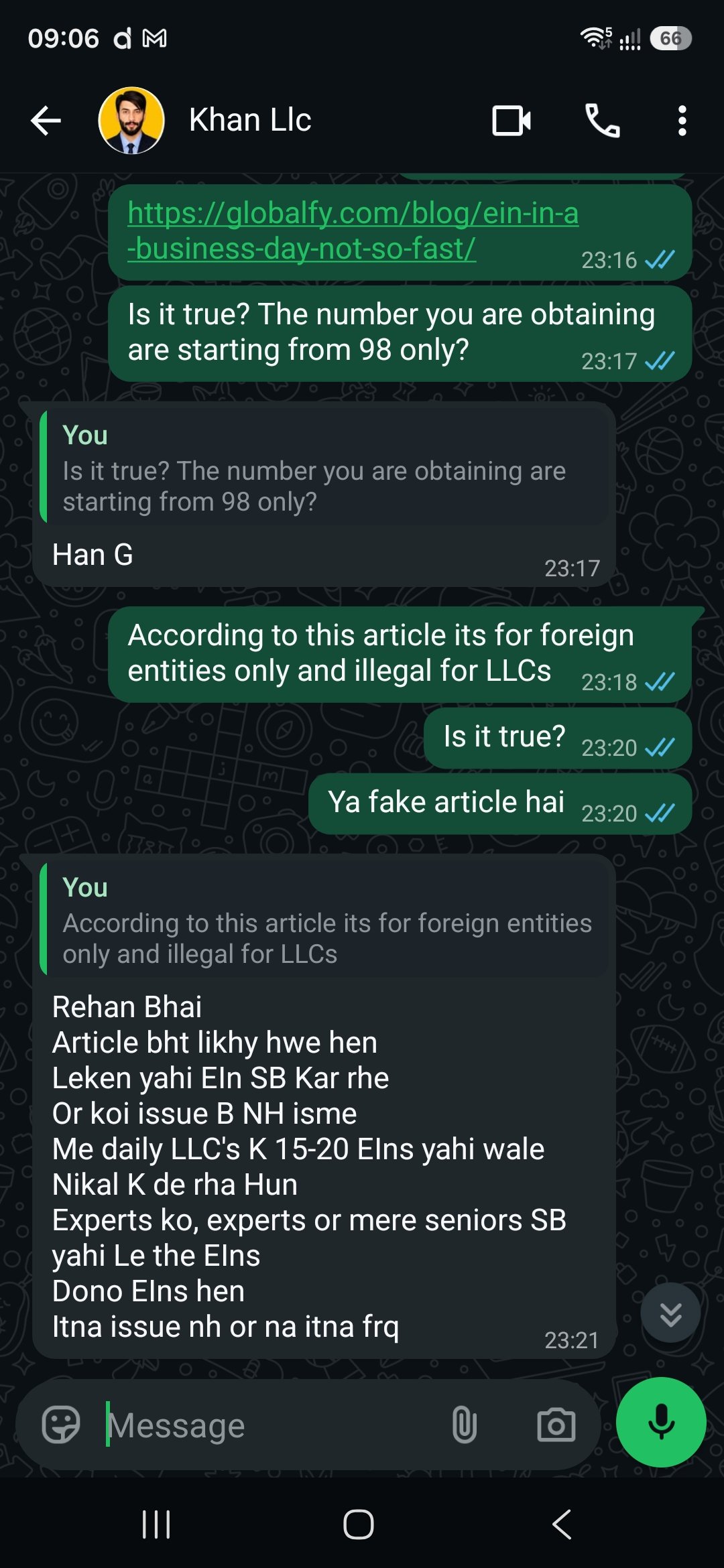
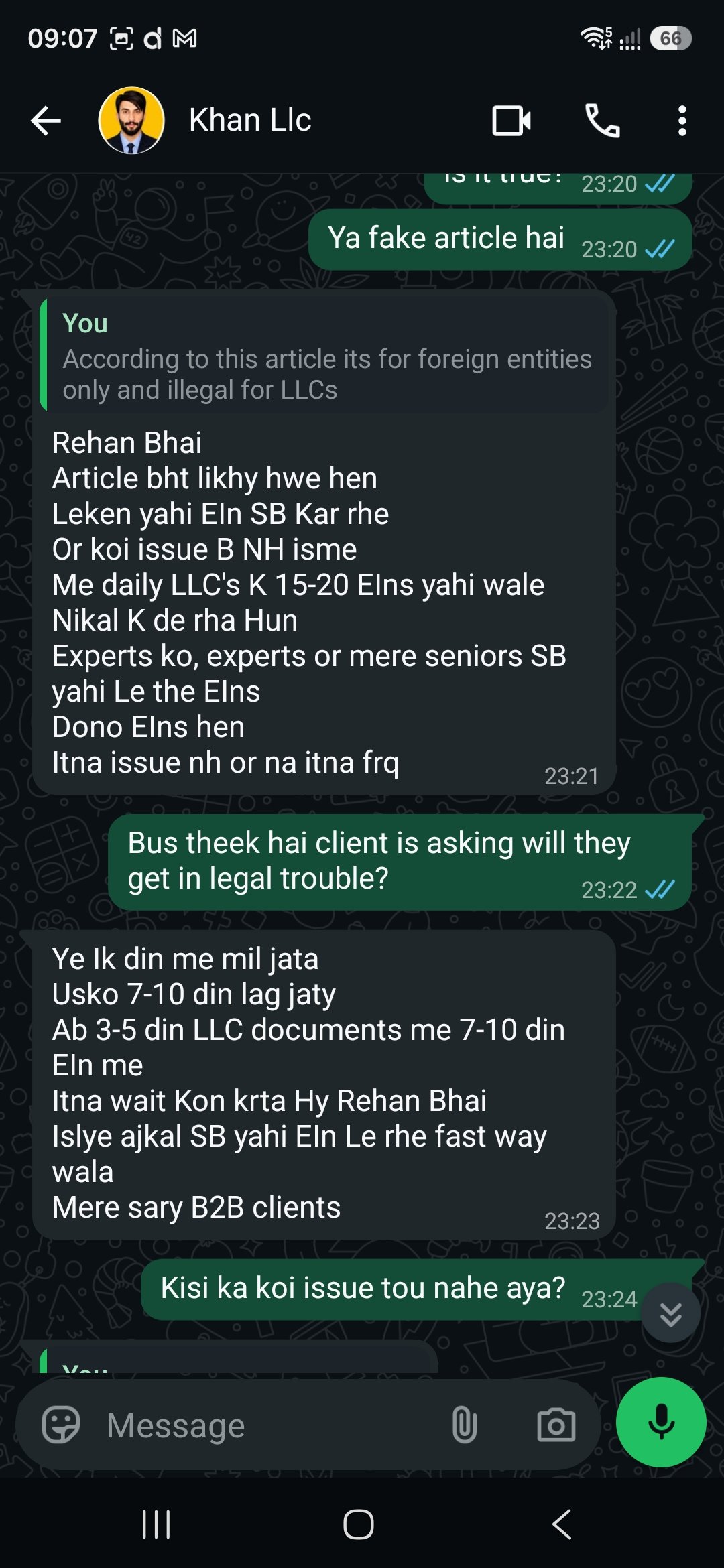
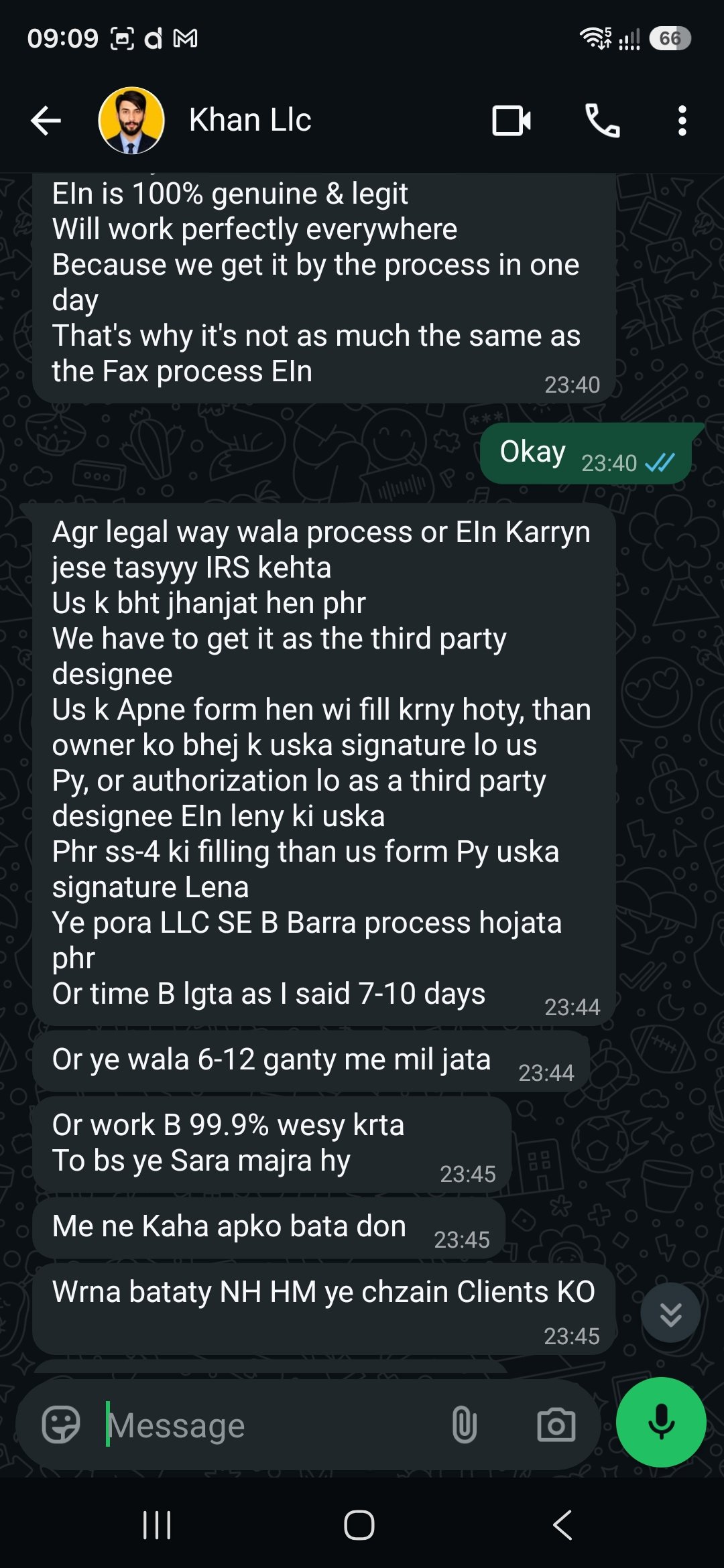
When I challenged him with what I had found, he didn’t say I had misunderstood the numbers. He dismissed the criticism and said other providers were doing the same thing. He told me he supplied 15 to 20 EINs a day to people he described as experts. I could see exactly how he responded when confronted with the classification problem: he defended the shortcut instead of addressing it.
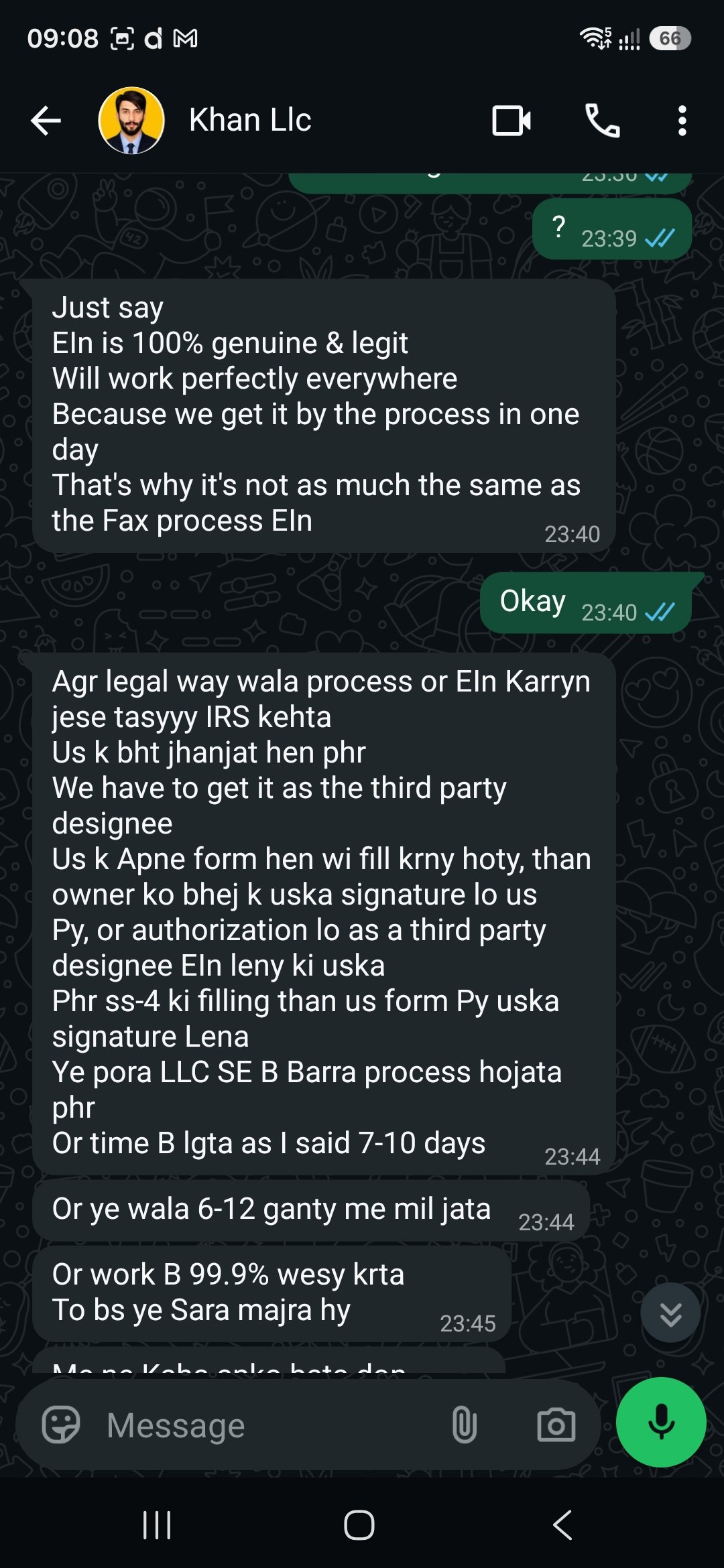
“EIn is 100% genuine & legit,” he wrote. “Will work perfectly everywhere.”
I already knew the EINs were genuine. I had the IRS letters. What I wanted to know was why a domestic LLC was receiving an EIN through the foreign-entity route and what the caller was telling the IRS.
His explanation distinguished two procedures. For the regular SS-4 process, he said the customer would have to sign the application and authorize a third-party designee, and he estimated seven to ten days. The other process produced an EIN within six to twelve hours. He described that one as different from the fax procedure.
The seller called the lawful IRS procedure too troublesome
At 11:44 p.m., EINbyKhan explained what would happen if he followed what he himself called the legal IRS process. He would prepare the paperwork, obtain the LLC owner’s signature, secure Third Party Designee authorization and submit Form SS-4. He called that process full of hassle and said it took seven to ten days. He then contrasted it with the method he was selling: six to twelve hours.
That distinction came from him, not from an outsider trying to discredit his business. He knew the customer-signed process. He knew that obtaining an EIN for a US-domestic LLC owned by a non-US founder required more than promising a number by tomorrow. Yet he was supplying 98-prefix EINs and defending the accelerated route because the resulting numbers were genuine.
At 11:45 p.m. he claimed that 99.9% of the work was done that way. He offered 99.9% as his own estimate of how widespread the practice was. I am reporting what the seller said, not turning his estimate into an industry census. What matters is that he was describing a method he considered normal within this market. Then he said, in Urdu, that clients were not ordinarily told these things. He distinguished the lawful paperwork from his fast route, described the lawful work as an inconvenience, and acknowledged that customers were not ordinarily told. That is the concealment at the heart of my investigation.
He also explained to me that callers presented themselves to the IRS as the actual LLC owners, first to obtain EINs and then to request Letter 147C. That is impersonation. The earlier exchange containing that explanation is no longer preserved; the WhatsApp screenshots document his 98-prefix admission, his distinction between the two processes and his statement about nondisclosure. I am not confusing a genuine EIN with a properly obtained EIN. The entire scheme depends on that confusion.
“Or ye wala 6-12 ganty me mil jata.”
Then he said something I haven’t forgotten: “Wrna bataty NH HM ye chzain Clients KO.” Otherwise, we don’t tell clients these things.
He knew the customer-signed process. He knew the method he was selling was different. He was reassuring me that it worked while acknowledging that customers were not normally told these details. I had been one of those customers myself, buying backend fulfillment and passing the result on to people who trusted my business.
It was not only the 98 prefix: the owner impersonation method
The more serious discovery came when he explained the IRS calls. According to what he told me during our August 2025 confrontation, the caller presented himself as the actual LLC owner to obtain the EIN, then contacted the IRS again as that owner to request Letter 147C, directing it to the provider’s fax number. The original Fiverr conversation containing that fuller explanation is no longer available, so I am reporting the explanation from my firsthand recollection. The surviving WhatsApp screenshots separately document his acknowledgment of the 98 prefix, his distinction between the two processes and his attitude toward disclosure to customers.
The WhatsApp messages document his 98-prefix admission, his own distinction between the customer-signed SS-4 process and the accelerated route, and his admission that customers were not ordinarily told. In an earlier exchange, he also told me directly about callers impersonating LLC owners before the IRS. I witnessed these conversations; I will not pretend the words he said to me somehow cease to matter because that earlier exchange was not preserved.
That distinction matters because a third-party designee is not the owner. An authorized representative is not the owner either. The IRS has procedures for allowing another person to assist with an EIN application, but the representative must act under the applicable authorization, not claim to be somebody else. The IRS’s responsible-party guidance also makes clear that the person named as responsible party must be the person who actually owns or controls the entity. A nominee cannot apply in place of that person.
Letter 147C adds another layer. It is IRS verification of an EIN previously assigned. The IRS does not simply send confidential EIN verification to anyone who knows a company’s name and address. Its procedures require authentication and appropriate authority. Under the current Internal Revenue Manual, a Third Party Designee’s authority is limited and does not entitle that person to receive Letter 147C by fax or mail. A taxpayer or a properly authorized representative is handled under different disclosure rules. IRS EIN assignment and 147C procedures.
So I was dealing with three separate issues: a domestic LLC receiving a foreign-series EIN, a contractor describing himself as the owner during IRS calls, and the same contractor describing how he obtained an IRS verification letter through that claimed identity. None of those questions disappears because the EIN is genuine.
I stopped using EINbyKhan in August 2025. I removed the accelerated-EIN positioning and began preparing SS-4 applications myself, obtaining signatures and using the IRS fax process.
Some applications came back sooner than others. Some took longer. I could control the preparation and submission of the form, but not the IRS processing queue.
I also began looking more closely at documents other sellers had prepared. In a separate transaction involving another provider, I examined an SS-4 bearing a signature that the customer had not provided or authorized, based on my firsthand knowledge of that case. The Third Party Designee section was blank. This document came from a different provider. The fact is simple: an SS-4 bore a signature the customer had not given or authorized. That is not a legitimate substitute for the customer’s signature.
Primary document: Masked SS-4 from a separate provider: examine signature and blank designee section.
A March 2026 SS-4 from my later work shows the customer-signed approach I used after changing my process. The designee section contains Enterobiz LLC and its business contact details. I am preserving those details in the public copy because I want the document examined as it was submitted. The IRS instructions specify a named individual in that field, so I am not presenting my own entry as a model of perfect compliance. I am showing the difference between obtaining a customer’s signature and inserting one without authorization.
Since September 2025, I have followed the customer-signed SS-4 procedure and the appropriate IRS submission route. I abandoned the shortcut as soon as I understood what had been happening behind the paperwork.
Primary document: Customer-signed SS-4.
Primary document: Alternate customer-signed SS-4 example.
August 28, 2026: I returned to Fiverr
By August 2026, I had enough experience with SS-4 applications to recognize the difference between preparing a form quickly and guaranteeing that the IRS would assign an EIN within hours. I returned to Fiverr under my own identity, approached sellers as a non-US founder with an American LLC and no SSN or ITIN, and recorded their responses and listings. These are recordings of what they offered me, not guesses about what their listings meant.
EINbyKhan’s renewed offer
EINbyKhan was still publicly advertising an LLC EIN and Letter 147C in as little as one hour for U.S. and non-U.S. owners. This was the seller whose backend procedure I had already challenged in 2025. His continued one-hour offer was therefore particularly significant to me.
Zain Sial offered an EIN within one business day after I explained that I was a non-US resident without an SSN or ITIN. Najam U told me he could obtain the number within approximately the next 11 hours if I ordered before the weekend; otherwise, we would have to wait until Monday. His explanation connected the delivery promise to IRS working hours, not merely the time required to fill in a form.
TaxZone’s two processing routes
TaxZone was more revealing. He distinguished the ordinary SS-4 fax procedure from another route he called direct IRS follow-up. The fax route depended on IRS processing. The accelerated route, according to his recorded explanation, could produce the EIN and Letter 147C in
approximately 12 to 24 hours. He was describing two different ways of handling the application, not just offering priority customer support.
Ammar Ul Haq marketed EIN services while referring to IRS Acceptance Agent credentials. I had already accepted a similar credential-based explanation from my original contractor in 2025. An acceptance-agent credential has a defined purpose; it does not answer which EIN procedure is used, who calls the IRS or what authorization the customer signs.
Rob’s Vetted Pro listing
Rob advertised a U.S. LLC and EIN within 72 hours. His Fiverr profile displayed Vetted Pro and Top Rated status, with Business Formation & Registration among the areas for which he was presented as vetted. Part of my conversation was handled by Fiverr’s buyer-facing Personal Assistant, which repeated the advertised timeframe. The listing itself made the promise regardless of what the assistant said.
Fiverr sells trust in this category. Its Vetted Pro badge and Top Rated labels sit beside offers involving federal tax identification, owner identity, and IRS correspondence. What exactly did Fiverr vet? Did anyone examine the application channel used for a domestic LLC owned by a non-US founder without an SSN or ITIN? Did anyone inspect who signs SS-4, who calls the IRS, or who receives Letter 147C? If not, what is the badge supposed to tell the buyer? A glossy marketplace credential cannot replace IRS authorization. Fiverr should explain what its professional vetting actually establishes before lending that credibility to accelerated-EIN promises.
Fiverr’s Vetted Pro badge does not answer the IRS questions
Fiverr needs to answer for the credibility it sells. Vetted Pro. Top Rated. Level 2. These badges are displayed beside offers involving US federal tax records, and customers are encouraged to trust them. So what, exactly, was vetted? Did Fiverr verify the legal EIN application channel for US-domestic LLCs whose non-US owners lack SSNs or ITINs? Did it check who signs Form SS-4, who identifies themselves to the IRS, and who is authorized to receive Letter 147C? If it did, publish the standard. If it did not, stop dressing these high-stakes offers in badges that suggest professional scrutiny. A marketplace cannot hide behind a star rating when the question is whether its sellers are using fraudulent identity and classification methods.
October 2026: I recorded another six sellers
The October investigation was separate from August 28. I recorded six seller conversations: Sunny, Saqib Ali, Abdullah A, Rob, Kadir Caa and MueedAhmad. Rob appeared in both rounds, but the recordings were made separately.
Sunny’s SS-4 signature offer
Sunny, a Level 2 seller, advertised an EIN and Letter 147C within 24 hours for U.S. and non-U.S. residents. During the conversation, he offered to handle the SS-4 signature. I wanted to know exactly what that meant because I had already encountered a document signed without the customer’s authorization.
The deliberate signature test: I acted like a confused, anxious non-US founder. When the seller told me to authorize him to sign SS-4, I asked what that meant and expressed anxiety. Rather than clearly explain the signature and the authority involved, he brushed it aside and offered to handle it. That dismissive response is exactly why the customer needs to see the form and know who is signing. This recording documents the offer and response; it does not itself show a completed forged filing.
Saqib Ali displayed Top Rated status and offered a 24-hour EIN service. Abdullah A, whose profile showed a 4.9 rating, advertised an EIN with Letter 147C in 24 to 48 hours. Rob’s 72-hour LLC and EIN offer remained part of the market I was examining.
Kadir Caa publicly advertised a 72-hour service but estimated three to five days in our private exchange. MueedAhmad advertised a 24-hour turnaround but told me approximately three days during our conversation. Those differences deserve attention because customers searching for a fast EIN are responding to the headline promise, not a revised estimate disclosed later.
I also examined publicly accessible Fiverr listings beyond these conversations. One listing by Inam Ul Haq advertised an EIN within 24 hours while its description discussed a three-to-four- business-day process for applicants without an SSN or ITIN. Another, by Amna EIN Expert, distinguished the service turnaround from actual IRS processing. Those are not equivalent representations, and customers should not have to discover the difference after clicking a headline promising a federal tax number by tomorrow.
This is a fraud investigation. I personally encountered a contractor who supplied 98-prefix EINs for US-domestic LLCs, described impersonating their owners on IRS calls, and admitted that customers were not ordinarily told about the method. Those are not harmless processing shortcuts. The recordings of other sellers show the promises being marketed in the same category: EINs and, in several cases, Letter 147C within hours. Every seller making such a promise should have to identify the actual IRS procedure, the applicant classification, the signer, the caller and the authorization for obtaining the letter. They are selling the service. The explanation is theirs to provide.
The websites making the same promises
The same market exists outside Fiverr, where the sales pitch often looks more authoritative because it appears on a dedicated company website.
1 Day EIN says a Wyoming or Colorado LLC should not receive a 98-prefix EIN through the foreign-entity route. It also advertises a one-business-day EIN service for non-US founders, including customers whose American LLCs already exist. Its About page says it acts as Third Party Designee, while its explanation of the fast service declines to publish the operational detail behind the turnaround. That is a direct question for the company: which IRS route consistently produces a domestic-series EIN for that customer within one business day, and how does the claimed third-party authorization fit that route?
Mizu Financial goes further in describing its method. In a June 2026 announcement, it advertised a same-day EIN add-on for foreign founders, explained that it prepares SS-4 with the founder as responsible party and Mizu as Third Party Designee, and described using IRS phone and fax handling paths for international applications. It says the EIN may be issued during an IRS interaction and does not guarantee an exact hour. The company should explain how its telephone handling distinguishes a foreign-owned American LLC from a foreign-organized entity under the IRS’s classification instructions.
Corpulate published an April 2026 article saying non-US residents can receive an EIN in as little as 24 hours with professional assistance, referring to accurate paperwork and direct IRS communication. That explains the sales pitch, not how an IRS-controlled assignment is made predictable within a day.
EZINCORPORATION markets an American LLC and a working EIN in 24 hours, while a guarantee section on the same site describes a refund if the EIN is not delivered within 48
business hours. LLCora promotes a 24-hour LLC package that includes an EIN, while its FAQ gives a 48-hour estimate for a non-resident EIN via SS-4 fax. Those are materially different clocks, and the websites should state clearly whether the headline refers to formation, submission or actual IRS issuance.
Altixia describes a customer-reviewed and signed SS-4 submitted by fax, advertising 48 to 72 business hours for applicants without an SSN or ITIN. That is a more specific account of its proposed paperwork than a generic claim about professional connections, but the IRS still controls when the EIN is assigned.
These companies do not need to expose a single customer’s private information to explain their procedures. I want to know the IRS application channel, the classification given for a U.S.- organized LLC, the identity of the caller, the signed authorization and the type of IRS confirmation delivered. I am not interested in another assurance that the EIN is genuine. I already bought genuine EINs from a contractor who told me he was pretending to be the owner.
Fiverr should explain what its badges actually certify in this category. If a seller is marketed as vetted for business formation and registration, does that review include how the seller communicates with the IRS, or is it limited to marketplace performance? Sellers who advertise 24 hours should explain whether that is their own preparation time or the IRS assignment time. Those who advertise an EIN and Letter 147C together should explain how they obtain the letter and who is authorized to receive it.
The IRS records remain after the order is closed
The current Form SS-4 instructions permit a foreign responsible party without an SSN or ITIN to enter “foreign” or “N/A” where appropriate. They do not make the American LLC foreign- organized. The IRS assignment manual distinguishes domestic LLCs from foreign entities for prefix assignment and directs domestic cases away from the international telephone route. The manual was revised in 2026, so I am using its current text to evaluate the services marketed today, not pretending every procedural sentence was worded identically when I first discovered the issue in 2025.
The consequences are not theoretical simply because an EIN is genuine. An EIN application establishes an IRS business tax account. If the wrong entity classification, responsible party, address or other information enters that account, the actual owner may have to investigate and correct the record. If a provider impersonated the owner to obtain Letter 147C, the problem also concerns access to taxpayer information and the identity the IRS believed it was dealing with. If a signature was placed on SS-4 without authorization, the question is who made a representation to the IRS in the customer’s name. These are separate matters, and none is cured by sending the customer a nine-digit number.
For an affected founder, the first practical consequence may appear when a bank or payment processor asks for verification and the documents do not match, when the IRS sends correspondence to an unexpected address, or when the owner tries to obtain confirmation directly and discovers that the record is not what they believed. The original number can be genuine while the application record is wrong. When that happens, the founder must investigate what was filed, who made the application, what authority existed and what the IRS actually recorded. The IRS provides procedures for correcting responsible-party and address information, including Form 8822-B where applicable, but correcting an inaccurate application is not the same as clicking a refund button on Fiverr.
Misrepresenting a domestic LLC as a foreign entity, impersonating its owner before the IRS, or signing a federal tax application without authorization are not clever service upgrades. They are deceptive acts with potential legal consequences. I have documented the impersonation method described to me and an unrelated unauthorized-signature incident. Fiverr should explain how it investigates such conduct, rather than treating customer ratings as a substitute for compliance.
That is what makes this market so ugly. A non-US founder pays for a US-domestic LLC’s tax identification number, receives an authentic-looking result, and has no reason to suspect that the seller may have used the wrong IRS classification or falsely claimed to be the owner. The seller collects the fee. Fiverr closes the order. The founder is left carrying the federal tax record. I have seen the method from inside this industry, and I refuse to treat it as a clever shortcut.
My challenge to the entire 24-hour EIN industry
Do not tell me your EINs are genuine. I have held genuine IRS letters in my hands. I know that part. Explain how you obtained them. Explain why a US-domestic LLC received a 98-prefix EIN. Explain who called the IRS, whose identity was used, who signed Form SS-4 and who was authorized to receive Letter 147C. Show the actual IRS procedure that permits the service you advertise. Not a testimonial, not a Fiverr badge, not a claim about your connections. The procedure.
I worked in this industry. I saw a contractor call the IRS-prescribed, customer-signed process too troublesome, defend the six-to-twelve-hour alternative, describe impersonating LLC owners and acknowledge that clients were not ordinarily told. I call that fraud. I call pretending to be the taxpayer impersonation. I call selling the result while concealing the method a scam against the founder who trusts you.
To Fiverr: what does Vetted Pro mean when the service involves federal tax identification and taxpayer identity? If your badge does not establish that the seller follows IRS procedures, explain that publicly. If it does, show what you checked. The non-US founders buying these services deserve more than a decorative trust signal.
My challenge is not limited to the sellers named here. It is open to every Fiverr seller, agency, and company promising a US-domestic LLC owned by a non-US founder an EIN in 24 hours. Show how you deliver the number, the IRS procedure you use, the classification you submit, the person who signs SS-4, and the authority under which anyone calls the IRS or requests Letter 147C. If your promise is legitimate, demonstrate it with documents and rules rather than badges, testimonials, or an assurance that the resulting EIN is genuine. Anyone who believes my findings are wrong is welcome to challenge them with evidence. I will correct a factual error if one is demonstrated. I will not retreat from calling the impersonation and concealed processing methods I encountered fraud. I am standing behind this investigation.

0 Comments
Questions, corrections, and useful additions are welcome.